
Those who grew up in the 80's would probably list MTV as
one of the most prominent elements highlighting that decade. Debuting in 1981,
it was a means of bringing together music and picture in a spectacular display
that could previously only be achieved at concerts. At the same time, Hasbro
was developing a fashion doll to compete with the everlasting popularity of
Mattel's Barbie. They finally came up with the idea to create a highly
accessorized and fashion-conscious doll -with a twist. The doll would be a
singer, patterned after pop stars such as Madonna and Cyndi Lauper. The idea
was to capitalize on both the music video craze and the fashions of the period.
So the plans began. They named the doll "M", a further
attempt to associate her with the MTV phenomenon. Much like other popular toys
and cartoons of the time, "M" had a secret identity. The twist was that her
identity swap was triggered by a pair of flashing earrings that were linked to a
hologram-projecting computer. Hasbro also gave her a band, which in the
brainstorming stages was to be comprised of all males. After some consideration
(and perhaps to help girls further identify with the dolls) they decided on a
female band instead. Her band now consisted of musicians Kimber, Aja, and Shana.
The plans were really beginning to take shape, when they discovered a…
View More
Those who grew up in the 80's would probably list MTV as
one of the most prominent elements highlighting that decade. Debuting in 1981,
it was a means of bringing together music and picture in a spectacular display
that could previously only be achieved at concerts. At the same time, Hasbro
was developing a fashion doll to compete with the everlasting popularity of
Mattel's Barbie. They finally came up with the idea to create a highly
accessorized and fashion-conscious doll -with a twist. The doll would be a
singer, patterned after pop stars such as Madonna and Cyndi Lauper. The idea
was to capitalize on both the music video craze and the fashions of the period.
So the plans began. They named the doll "M", a further
attempt to associate her with the MTV phenomenon. Much like other popular toys
and cartoons of the time, "M" had a secret identity. The twist was that her
identity swap was triggered by a pair of flashing earrings that were linked to a
hologram-projecting computer. Hasbro also gave her a band, which in the
brainstorming stages was to be comprised of all males. After some consideration
(and perhaps to help girls further identify with the dolls) they decided on a
female band instead. Her band now consisted of musicians Kimber, Aja, and Shana.
The plans were really beginning to take shape, when then discovered a single
letter cannot be copyrighted, so they had to forgo the idea for the name "M".
Realizing this fact a bit late, production of the Kimber doll's keyboard had
already begun and displayed the "M" logo. So, in order not to vary the
name too much, they changed it to
"Jem". The Jem doll came with two outfits
-one
being her stage costume, and the other a business outfit for her
"day job" as Jerrica
Benton. Each of the dolls also came with a cassette featuring the theme song
and the band's "hit singles". A number of play sets were also available, each
with a "secret identity" of its own, i.e. an amplifier that became Jem's
dressing room, a keyboard that doubled as a bed, a guitar that turned into her
stage (much along the lines of the
"
Transformers" concept). Of course, Jem was
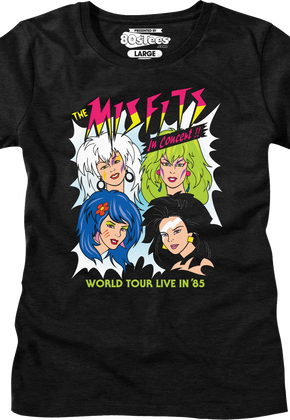
also given a boyfriend, Rio, and a rival band, The Misfits, consisting of
Pizzazz, Roxy, and Stormer.
The Jem concept already had great potential. But
Hasbro, taking it one step further, approached Marvel Productions about turning
it into a cartoon as well. In 1985, Marvel launched the
"Jem and the Holograms" cartoon
as a segment in their weekly
Super Sunday 90 minute animated block.
Viewers got to learn all about how Jem and the Holograms started their
band, their record label, "Starlight Music" (who also funded an orphanage, the
Starlight Foundation), the Misfits rivalry with them, and other juicy tidbits
about the
world of the mysterious, yet truly outrageous singer. Animated music videos,
similar to MTV style, were also featured, with many of the same songs that were
included with the dolls. The show was so riveting and full of twists and
surprises, it was almost like a children's soap opera.
Between the dolls and the cartoon, the public went crazy.
Soon Jem EVERYTHING was turning up on the store shelves - sticker books,
Halloween costumes, lunchboxes, backpacks, t-shirts, sweatshirts, puzzles, and a
plethora of other items. Jem was hot-and America only wanted more. The Super
Sunday segment spun off into its own show, and Hasbro began producing more dolls
and accessories to the line. They added Raya, Danse, Video, and Synergy to the
Holograms, and Jetta and Clash joined the Misfits. They even added three of the
orphans from the Starlight Foundation. Little girls could now play out entire
scenes from their favorite cartoon.
The Jem craze lasted about two years, and then sales
started to fizzle. One theory is that Jem's size (she stood a full inch taller
than Barbie) was a contributing factor in her demise. All those dolls and doll
clothes got expensive, and parents couldn't see forking out all that money for
items that wouldn't also fit Barbie. Or perhaps, the public couldn't comprehend
a "rock and roll" doll staying in the limelight for very long. Whatever the
reason, Hasbro discontinued the line in 1987. Nevertheless, Jem continues to
be "Truly Outrageous" to nostalgic fans and doll collectors.
View less