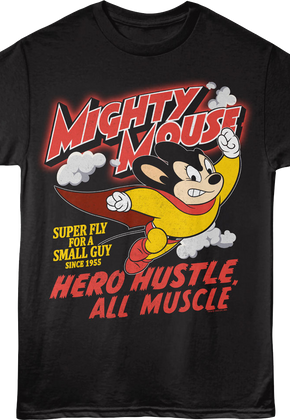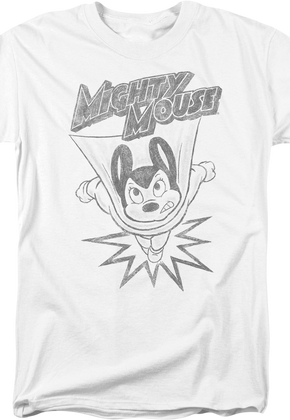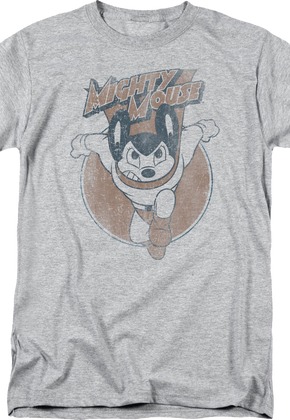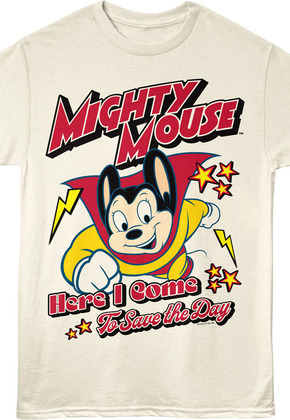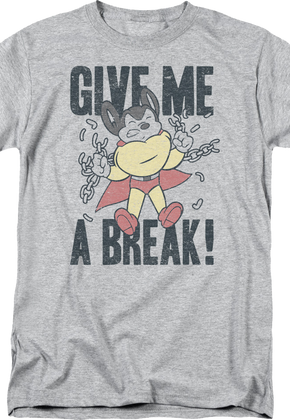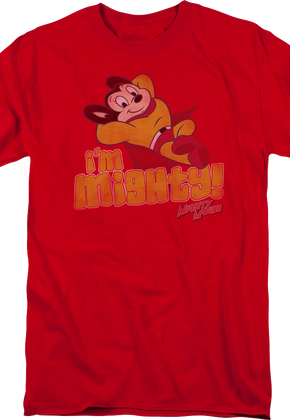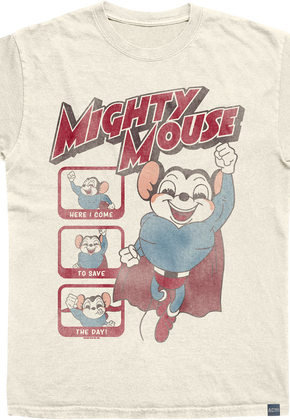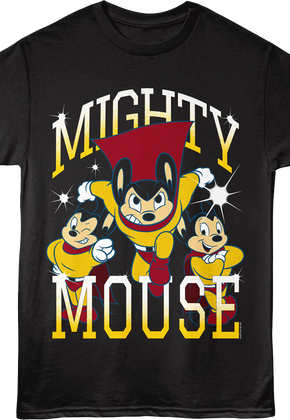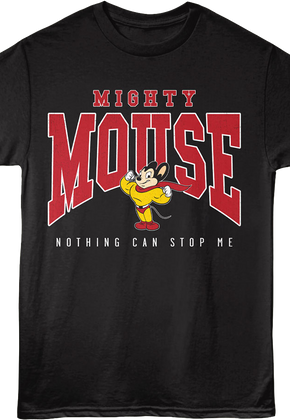

Fans of Mighty Mouse may
be surprised to hear that the heroic rodent actually got his start as an insect.
But it was that exact idea that story man Izzy Klein proposed to Paul Terry of "Terrytoons"

in 1942. His idea for "Super Fly" poked fun at the popular Superman comics by
featuring an ordinarily weak, miniscule creature which possessed superheroic
abilities. Having a reputation for only promoting his own ideas, Terry shot
down the "Super Fly" concept, only to change it to a mouse and pass it off as
his own brainstorm later on. He named the character "Super Mouse" and
incorporated the same concepts Klein originally proposed for the fly. During
Super Mouse's beginning stages, his attire was very similar Superman's, adorned
in a red and blue costume. Later on, revisions were done and eventually the
ensemble was changed to the classic yellow attire we are all familiar with.
Right around the time of Super Mouse's big debut in October 1942, it was discovered that a different Super
Mouse character was already in the works at Nedor Publishing Co, and that its
release date was also set for the same month. After some consideration, Terry
decided to change the name of his character to "Mighty Mouse" to differentiate
between the two. The previous releases of the Terrytoons production were altered
to reflect the new name.
Soon, Mighty Mouse became the…
View More
Fans of Mighty Mouse may
be surprised to hear that the heroic rodent actually got his start as an insect.
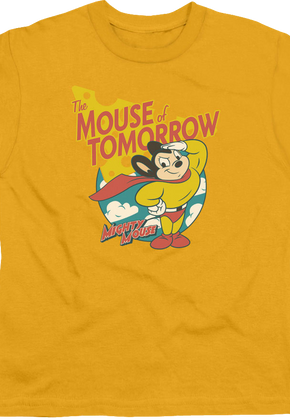
But it was that exact idea that story man Izzy Klein proposed to Paul Terry of "Terrytoons"
in 1942. His idea for "Super Fly" poked fun at the popular Superman comics by
featuring an ordinarily weak, miniscule creature which possessed superheroic
abilities. Having a reputation for only promoting his own ideas, Terry shot
down the "Super Fly" concept, only to change it to a mouse and pass it off as
his own brainstorm later on. He named the character "Super Mouse" and
incorporated the same concepts Klein originally proposed for the fly. During
Super Mouse's beginning stages, his attire was very similar Superman's, adorned
in a red and blue costume. Later on, revisions were done and eventually the
ensemble was changed to the classic yellow attire we are all familiar with.
Right around the time of Super Mouse's big debut in October 1942, it was discovered that a different Super
Mouse character was already in the works at Nedor Publishing Co, and that its
release date was also set for the same month. After some consideration, Terry
decided to change the name of his character to "Mighty Mouse" to differentiate
between the two. The previous releases of the Terrytoons production were altered
to reflect the new name.
Soon, Mighty Mouse became the
hottest animated character at Terrytoons. He was featured in a number of "mellerdramas",
which were cartoons done in opera-style singing rather than simply spoken word.
The first of Mighty Mouse's mellerdramas was
Mighty Mouse and the Pirates,
released on January 12, 1945. A number of other characters were also
introduced, including Oil Can Harry, who was an earlier Terrytoons character
rewritten as a cat for the Mighty Mouse adventures. Pearl Pureheart was also
introduced as the cartoon's "damsel in distress".
Later the same year, Mighty
Mouse began starring in a series of comic books, "Terrytoon Comics". He
eventually got his own self-titled comic in 1946, which was published until the
1960's. In 1945,
Gypsy Life, a cartoon featuring the valiant mouse, was
nominated for an Oscar. It was one of four Terrytoons cartoons to receive such
an honor. In the 1950's Paul Terry sold his Terrytoons library to television,
and Mighty Mouse became the first-ever Saturday morning cartoon character in
"The Mighty Mouse Playhouse". This series ran from 1955 to 1967, and featured
Mighty Mouse along with a compilation of other Terrytoon classics.
After a hiatus that lasted over
a decade, Mighty Mouse returned to television in an animated series produced by
Filmation (whose credits include
Fat Albert and
He-Man and the Masters
of the Universe) in 1979. However, the poor animation resulted in the series
being canceled after just sixteen episodes. In 1987, another attempt at bringing
Mighty Mouse back to Saturday mornings was made by Ralph Bakshi, a former
Terrytoons director.
Mighty Mouse, the New Adventures had much better
audience reception than its 1979 predecessor, introducing Mighty Mouse's secret
identity Mike Mouse and the addition of more supporting characters. The series
lasted 38 episodes, though, most likely due to the fact that the cartoon seemed
to be aimed more toward adults than to children.
Although no new Mighty Mouse
cartoons have come to television in awhile, he still remains a classic to
cartoon fans everywhere. Many Mighty Mouse items such as clothing, patches,
figurines, and keychains are still widely available. This proves that the
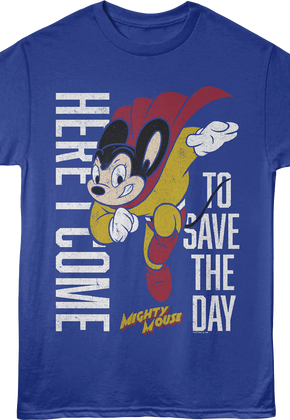
famous cry, "Here I come to save the day!" still lives on even since his debut
over 60 years ago.
View less